Unique Lanzarote
Unique Lanzarote
The long and fascinating history of Lanzarote wine

Are you 18 years old or older?
Sorry, the content of this store can't be seen by a younger audience. Come back when you're older.

Lanzarote is one of 8 Canary Islands, located 80 miles off the coast of Africa. With its desert like climate and rainfall of just 150 ml a year on average, wine production is a surprise to most as it sits well outside of the geographic norm for winemaking.
The history of Lanzarote wine is long and fascinating and it follows the tale of man’s constant battles against adversity, that of the climate and the changing landscape. Winemaking is in the lifeblood of the Island. With a population of 150,000, there are nearly 2,000 registered viticulturists and 21 wineries making up the Denominacion de Origen, all playing their part in keeping this fantastic culture and tradition alive. Our 5 native varieties, escaped the Phylloxera plague, are ungrafted and often well over 100 years old, which just adds to the tale.
The Canary Islands once produced world famous wines, drunk by royalty, aristocrats and writers; Shakespeare was a huge fan. In fact, millions of litres of Sack or Malmsey as it was known (the nickname for the Malvasía grape) was exported to the UK and America between the 16th and 18th centuries.
Prior to the 18th century, wine production simply wasn´t possible, but between 1730 and 1736, Lanzarote had a constant flow of volcanic eruptions, in what is now known as the Timanfaya National Park.
This shaped much of Lanzarote as we know it today, as around 30% of the Island was affected and precious fertile soil was buried beneath lava and volcanic ash, known as rofe or picon.
Prior to the eruptions, this central farmland would have been the breadbasket of Lanzarote. Cereal crops would have grown in abundance, but in this new landscape it was no longer possible and alternative crops were sought, and where better to start than with vines!
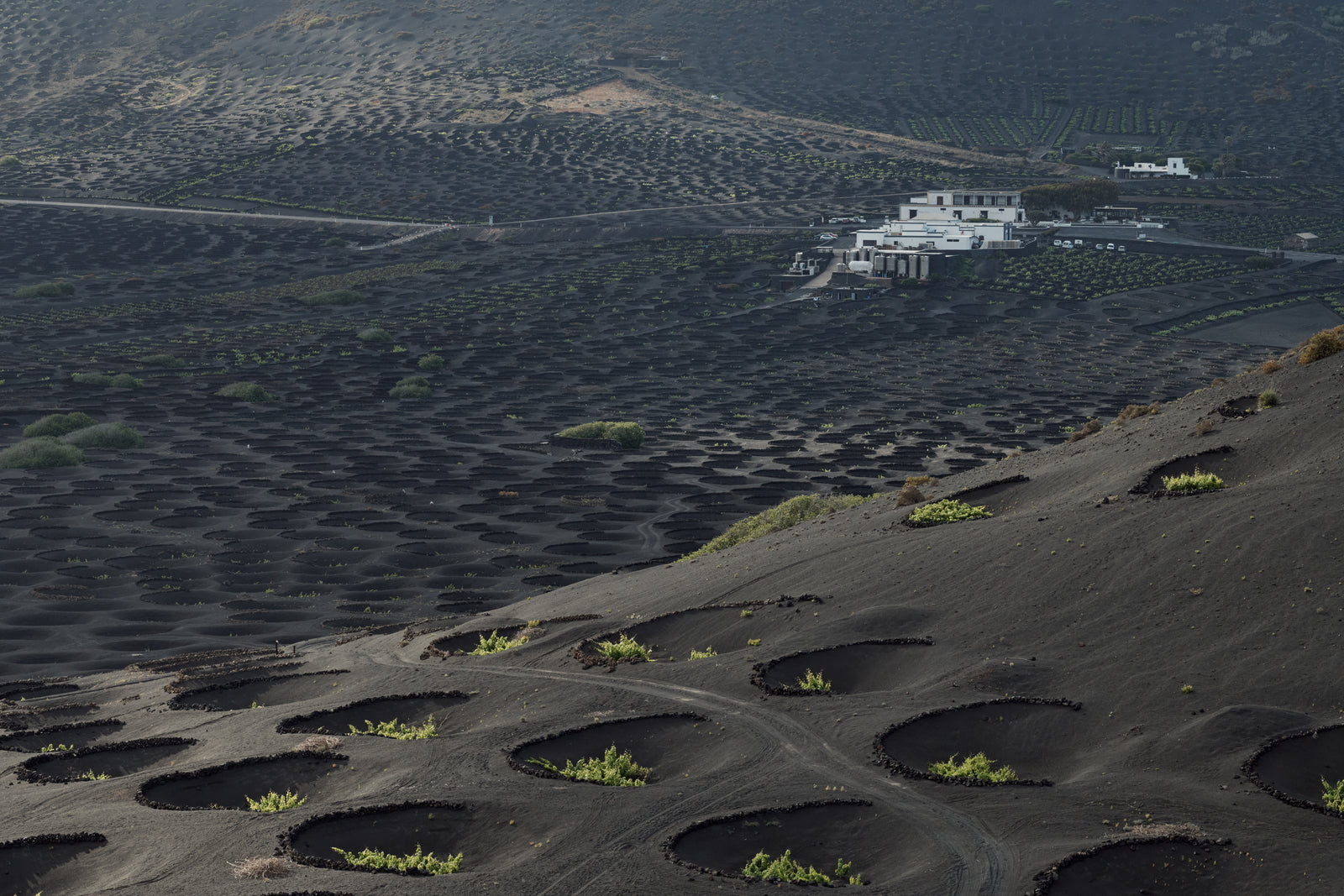
The first vines were planted in the soil lying below the rofe, in some cases this meant the farmer manually digging holes, often 4 meters wide by 3 deep, until they reached the soil. Usually a dry stone (lava) semi-circular wall known as a zoco was then built around the hole, facing North to protect against the strong trade winds. Those pioneering farmers soon saw the vines flourish.
They realised that rofe retains moisture (rain and humidity), and locks it into the earth allowing the vines to survive. Lanzarote only receives 150ml of rain per year on average and the vines are not watered by manual irrigation, even today. It is thanks purely to the rofe and nature that they survive.
This landscape and style of cultivation is still intact today, thanks to regular manual maintenance and protection. It forms the heartland of the Lanzarote wine region known as La Geria. It is a truly unique landscape and viticulture that must be seen to be believed.
The unique cultivation is typified in the holes of La Geria as described above, but as you head further away from La Geria and north (up wind) the rofe is thinner and you will find vines planted in rows, crawling and hiding behind lines of stone walls. Here you will find up to 900 vines planted per hectare, versus as low as 300 vines per hectare in the holes of La Geria. To make a comparison, a typical European vineyard would have around 3,000 - 7,000!
Another type of cultivation takes place in Chabocos. These are narrow cracks or gullies in a solid lava flow where soil is still accessible at the bottom. The gullies are often over 3 meters deep with vines trained to grow out. Often you will find Moscatel planted as this varietal enjoys a little more water and the hard landscape surrounding the Chaboco acts as a funnel for any rainfall.
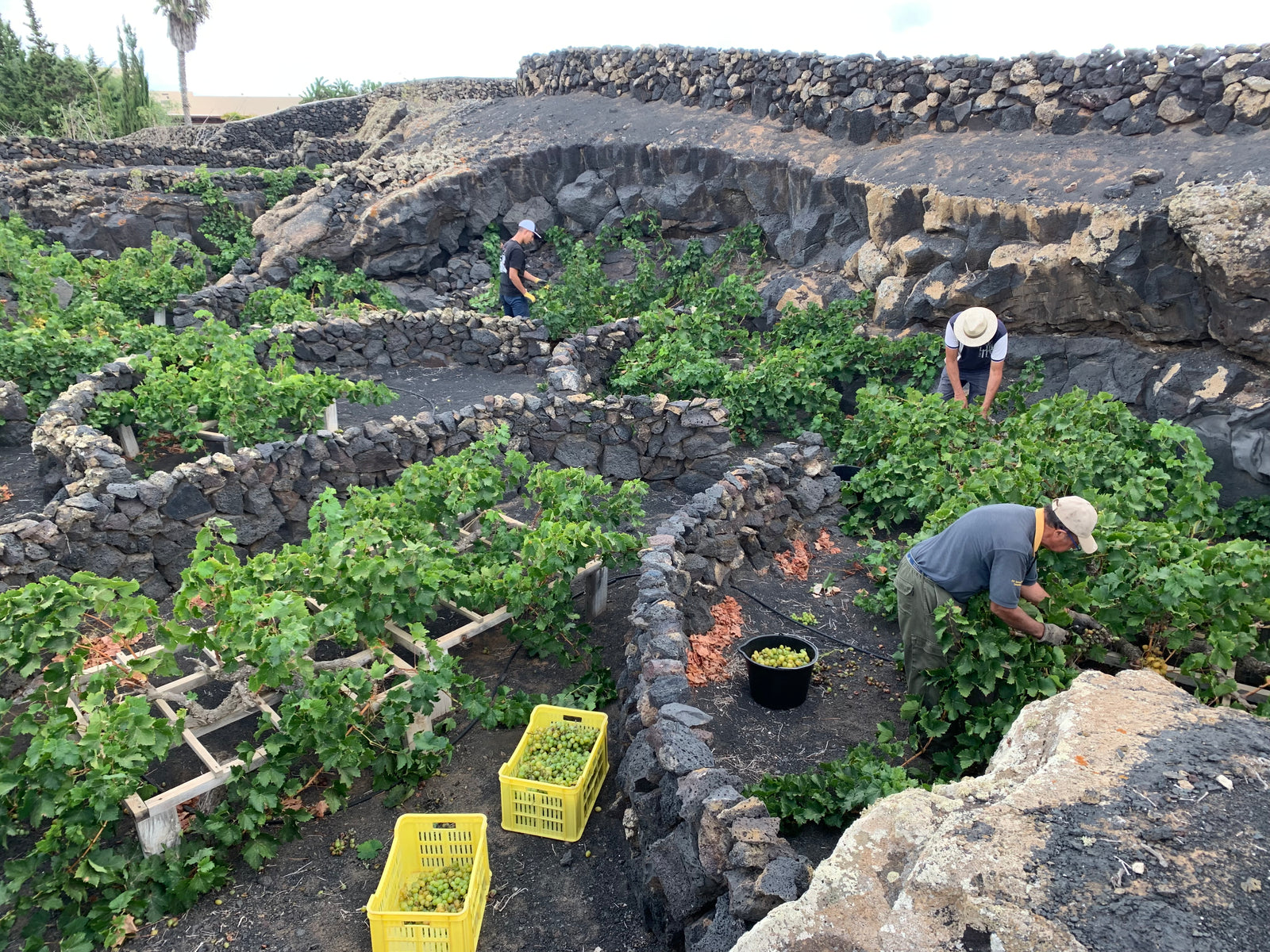
The Harvest is the first in Europe, usually from mid-July. Harvest is a very manual exercise in the heat of the summer. It´s a rule set by the Denominacion de Origen, not least because of the impassable landscape, but importantly it ensures quality. Picking by hand ensures that only the premium bunches are harvested, and then they are carefully placed in a basket containing approximately 20 Kg. This ensures the grapes are not damaged and arrive to the winery in perfect condition. You will see harvesting at first light when the conditions are at their coolest. We always get enough sun on the Island, so quality is high year after year, but one thing that does change drastically is the annual yield. A lot depends on the winter weather, for example, in 2016 we had a yield of just 696,000 Kg and then 3,943,000 Kg in 2018, which was a record year for collection.
The vines escaped the 19th century Phylloxera plague which decimated almost all of Continental Europe´s vineyards. Even today vines have to be grafted on the Continent with Phylloxera resistant, North American rootstock. The grafted vines though mean that European vineyards need to be replanted on a rolling 50-year basis as the vines lose their strength. In Lanzarote this is not the case and vines can keep on producing year after year, with many well over 125 years old.
To learn more, we offer a visual presentation and tasting with our sister company Wine Tours Lanzarote. They will join you on a Zoom online call and take you on a ´Journey Through Lanzarote Wine’. More info can be found here.